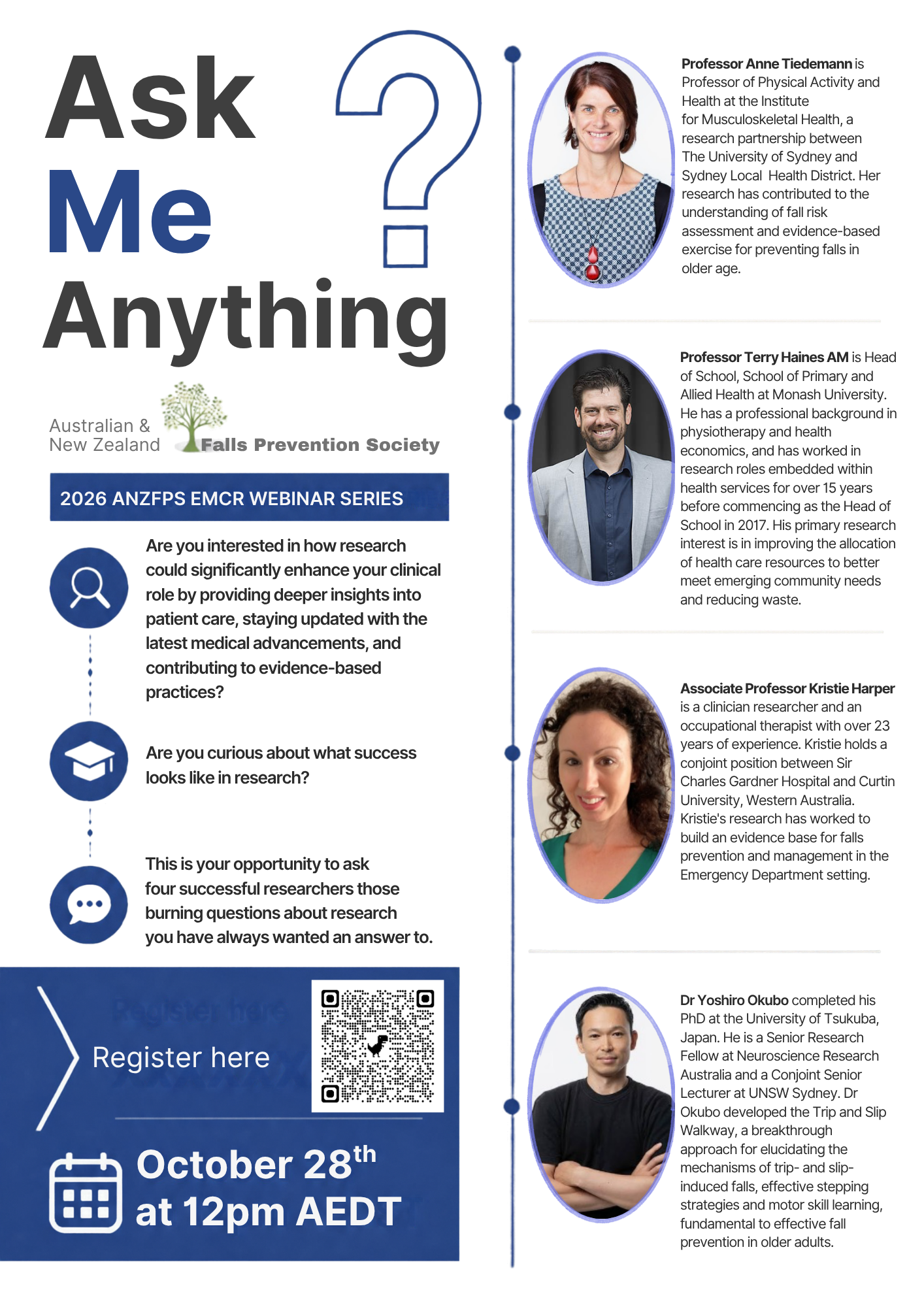
ANZFPS EMCR Webinar Series – Ask Me Anything

The next Australia and New Zealand Falls Prevention Conference will be held in Christchurch, New Zealand, 21-23 November 2027. Watch this space for more information on speakers
There have been a number of articles published on falls in recent weeks surrounding the release of the Australian National Fall Guidelines.
Hosted in partnership between the CRE in the Prevention of Fall Related Injuries, The Australia New Zealand Falls Prevention Society and Injury Matters, this informative webinar introduced the newly released Preventing Falls and Harm from Falls in Older People: Best Practice Guidelines (2025), developed by the Australian Commission on Safety and Quality in Health Care. These comprehensive, evidence-based guidelines provide best practice recommendations for preventing falls in hospitals, residential aged care, and community care settings. This video offers an overview of the updated guidelines, their development and discuss their application across various care environments. Viewers will hear from contributors involved in the development of the guidelines and gain insights into person-centred strategies to reduce falls risk and support healthy ageing.
In this new Croakey article, Prof Anne Tiedemann, A/Prof Jasmine Menant, Prof Kim Delbaere and Prof Cathie Sherrington write:
“We now need government leadership, sustained investment and coordinated action to prevent avoidable harm, and ensure all Australians can age with confidence, mobility and independence”.
Read about what needs to happen to ensure the new National Fall Prevention Guidelines create real change.

Presented by the ANZFPS Early-Mid Career Researcher Sub-Committee
Presenters: Dr Benignus Logan and Sandeep Gupta
Friday 30 May
Links from the webinar:
– Physiotherapy Evidence Database (PEDro) – Worldwide Journal club
– The Asia-Pacific Clinical Practice Guidelines for the Management of Frailty
– British Geriatrics Society – Fit for frailty
– Agency for Clinical Innovation – Frailty Taskforce
– Northern Sydney Frailty Initiative
– Intergenerational playgroups
 Dr Benignus Logan is a specialist geriatrician in Brisbane. He is in the final stages of completing his PhD which has examined frailty and goals of care in older people living with chronic kidney disease. Benignus works with the Australian Frailty Network, and established Frailty Nexus as a community of practice for researchers and healthcare professionals with an interest in frailty. Benignus will present an introduction to frailty, including its prevalence, how to measure it and give us an overview of the current research on frailty being undertaken by the Australian Frailty Network (AFN).
 Sandeep Gupta is the Head of Physiotherapy at Canterbury Hospital, Sydney. He has been the Co-chair of the Agency for Clinical Innovation’s Frailty Expert Advisory Group and a member of the Executive for the ACI’s Frailty Taskforce. Sandeep has a Masters by research, is actively engaged in research and is a co-author on six peer reviewed publication. Sandeep will present an overview of clinical applications of frailty, including interventions designed to improve the patient outcomes for people treated for frailty.
Presented by the ANZFPS Early-Mid Career Researcher Sub-Committee
Presenters: Associate Professor Elissa Burton
HELD: Thursday 16th, May, 2024 Time: 12pm – 1pm AEST
Where: Zoom webinar
Associate Professor Elissa Burton provided an overview of her systematic review on whether interventions are effective in improving the ability of older adults to get up off the floor independently and the two main methods used. Elissa outlined her kinematic research that identified three main methods, with different methods used across three stages (i.e., initiation, weight transfer, transition to stand) that older adults use to get up from the floor. Finally, Elissa outlined practical considerations of therapeutic/exercise interventions targeting capacity to independently get up from the floor.
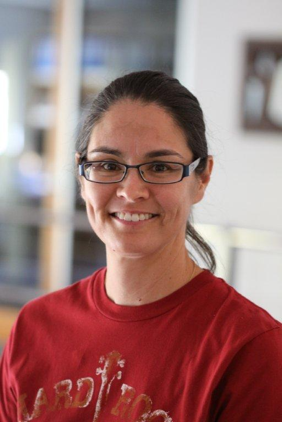 Elissa is an Accredited Sport Scientist (Level 2) and an Associate Professor at Curtin University in Western Australia. Elissa’s research focuses on helping older adults to live independently at home for as long as they choose, through healthy living strategies. Much of Elissa’s work has been with older adults who receive home care services, reablement or restorative care, promoting physical activity, preventing falls and getting off the ground, and encouraging healthy older adults to participate more in strength and balance training. She is a current NHMRC Investigator Grant holder and a Fellow of the Australasian Association of Gerontology (AAG).
With Presentations from Dr Jennie Hewitt and Rik Dawson.
Presented by the ANZFPS Early-Mid Career Researcher Sub-Committee
Presenters: Dr Jennie Hewitt and Rik Dawson
Dr Jennie Hewitt will discuss the implementation of Sunbeam (successful fall prevention intervention) into RACF. Rik Dawson will discuss his experience delivering fall prevention exercise using telehealth focusing on the user experience. Jennie and Rik will also discuss how AN-ACC has influenced fall prevention activities and provided opportunities for practice change in RACF.
Dr Jennie Hewitt is a physiotherapist, educator, and academic researcher with a passion for delivering best practice. She has been awarded an Australian National Lifetime Achievement Award, and a National Commendation for Better Practice for her work on the Sunbeam Aged Care Exercise Program. She attained the Morley Award, for the paper most likely to influence policy and practice, from the Journal of the American Medical Directors Association. Her work has been used to advocate for Australian Aged Care Funding Reform, she appeared as an expert witness at the Royal Commission and has worked as Technical Advisor to the Federal Chief Allied Health Officer on the implementation and scaling of the Sunbeam Program in 119 aged care facilities across Australia. In 2022 she won the innovAGEING award with Whiddon for a project that used exercise to address chronic pain and deconditioning and in 2023 she was named as an Ageing Asia Global Trailblazer.
Rik Dawson graduated from Sydney University in 1993. Rik is a titled Gerontological Physiotherapist, Vice President of the Australian Physiotherapy Association (APA) and the APA representative on the Aged Care Quality Standard Clinical Working Group. Rik was the owner of Age well Physiotherapy, a practice that employed physiotherapists and occupational therapists in Aged Care across Australia. Rik sold his practice in 2020 and is now enrolled at Sydney University as PhD candidate where he is focusing on telehealth for older people. Rik is a graduate of the AICD and has been a Director of the APA since 2017. Rik was a member of the Audit and Risk Committee and the Director member on the Physiotherapy Research Foundation where he worked to connect research to policy and practice. Rik currently chairs the Nominations, Remuneration, and Governance Board sub-committee. He has a passion for communication, advocacy, leadership and good governance. Rik believes that linking strategy to member value is key to non-profit organisation’s success.
| Centre of Research Excellence: Prevention of Falls Injuries A research collaboration funded by the National Health and Medical Research Council. They strive to extend our knowledge base by linking with stakeholder groups to co-create, implement, scale-up and evaluate strategies designed to reduce fall-related injuries. They support and guide implementation of evidence-based falls prevention strategies into policies, practices, and programs. |
| Australian Centre for Evidence Based Aged Care (ACEBAC) La Trobe University The ACEBAC are passionate advocates of person-centred, evidence-based care of older people. Their research has a focus on translating evidence into the real world and making a quality difference for older people, families and staff. |
| Centre for Research Excellence in Patient Safety (CRE-PS) Monash University The CRE-PS was established to design, conduct, promote and promulgate high-quality multi-centre research to improve the quality, safety, efficiency and effectiveness of health care for Australians. Their work focuses on four main areas: - Using data to monitor quality of care - Improving information transfer - Reducing medication error - Patient Safety |
| Falls, Balance and Injury Research Centre (FBIRC) Neuroscience Research Australia and the University of New South Wales The FBIRC conducts research into understanding human balance, fall risk factors and strategies for prevention of falls in older people. The overarching aims involve: 1. Accurate documentation of falls and fall injuries 2. Identification of falls risk factors 3. Development of feasible fall prevention strategies 4. Effective management of people with a fall related injury |
| National Ageing Research Institute (NARI) NARI is a national, independent medical research institute that makes a measurable difference to the lives of older people and those who care for them by improving their quality of life and health. Their research focuses on seven key areas: - Falls and balance - Pain - Dementia - Physical Activity - Healthy Ageing - Psychosocial and mental health - Health systems evaluation |
| The Joanna Briggs Institute University of Adelaide JBI is concerned with improving health outcomes in communities globally by promoting and supporting the use of the best available evidence to inform decisions made at the point of care. They also offer a range of evidence-based practice tools and resources such as systematic review and clinical audit tools, evidence-based point of care resources and offer varied educational programs. |
| Flinders Health & Medical Research Institute (FHMRI) Injury Studies Flinders University FHMRI Injury Studies contributes to understanding the nature, causes and effects of human injury and to reducing its occurrence and consequences. They undertake research, surveillance, analysis, consultation, teaching, as well as dissemination of information on injury control and related matters to public health and other practitoners, academics, government and the community. |
| Queensland Injury Surveillance Unit (QISU) QISU collects Level 2 injury surveillance data from participating hospital emergency departments across Queensland and produces bi-monthly bulletins that analyses data according to specific injury topics and sets that data in the context of relevant local, nation and international research and policy. |
| Institute for Musculoskeletal Health (IHM) University of Sydney, Syndey Local Health District The IHM brings together musculoskeletal healthcare researchers and clinicians who have direct contact with patients in the health system. Their vision is to optimise musculoskeletal health and physical activity through high quality, patient-centred collaborative research. Their research themes are: • Surgery • Healthy Ageing • Intervention Testing • Children and Adolescents • Disability • Physiotherapy Evidence Database (PEDro) |
| Australian and New Zealand Hip Fracture Registry (ANZHFR) The ANZHFR is a clinical registry that collects data on the care provided, and the outcomes of care, to older people in Australia and New Zealand, admitted to hospital with a fracture of the proximal femur. The registry is a collaborative project between several professional societies and is one of a number of complementary initiatives designed to improve hip fracture care bi-nationally. |
| The Neurology, Ageing and Balance Research Group The University of Queensland The focus of the research team is to investigate changes in impairments, activities and participation, particularly relating to balance and gait, that occur with age, pathology or that are acquired through injury. Client-centred focus areas of the team include older adults (healthy, fallers); people with neurological disorders such as stroke, Parkinson’s Disease and Multiple Sclerosis; and adults with musculoskeletal disorders such as hip osteoarthritis or neck pain. |
| LiLACS NZ Research Programme The University of Auckland Life and Living in Advanced Age, a Cohort Study in New Zealand, otherwise known as LiLACS NZ, is a longitudinal cohort study of New Zealanders living in advanced age. It aims to determine the predictors of successful advanced ageing and understand the trajectories of health and wellbeing in advanced age in a Māori and non-Māori New Zealand population. |
| Centre for Health, Activity, and Rehabilitation Research (CHARR) University of Otago The Centre for Health, Activity and Rehabilitation Research (CHARR) is the research centre for the School of Physiotherapy at Otago. Research areas include: - Physical Activity and Health - Healthy Ageing - Sports Concussion and Injury Prevention - Clinical Biomechanics and Medical Technologies |
| Rehabilitation Innovation Centre Auckland University of Technology The Rehabilitation Innovation Centre comprises a multi-disciplinary team of physiotherapists, bioengineers, and computational neuroscientists. Research is embedded in clinical practice and focuses on the development and implementation of innovative health technologies, measurement tools, and interventions to improve health outcomes for people with neuropathology across their life span. |
| Injury Prevention and Mobility Laboratory (PML) and Technology for Injury Prevention in Seniors (TIPS) Simon Fraser University (Canada) TIPS is a unique university-community partnership for developing new technologies to prevent falls and fall-related injuries in older adults. TIPS uses innovative approaches (such as video capture and wearable sensors) to determine the causes and circumstances of falls of older adults. We also develop and test the effectiveness of engineering interventions such as protective clothing and compliant flooring in reducing fall-related injuries. |
| Centre for Hip Health and Mobility University of British Columbia (Canada) The Centre for Hip Health and Mobility (CHHM) is focused on developing novel strategies that promote physically active choices that positively influence mobility. |